" I challenge the dominant narrative of Western modernism, to promote the restoration of Art dignity"

Figurative art as a bulwark against late modernism.

Being a figurative artist nowadays… after a century of indifference toward traditional culture and artistic heritage, at a time when ultra-pervasive digital technology allows with a single click to generate artificial images instantly… being an artist must be interpreted as an act of Faith in favor of the uniqueness of the inimitable potential of the Human being; an act of non-submission to the prevailing technocracy that is sweeping away the poetry of existence, shaping cold steel hearts that no longer feel emotions.

Art is the expression of the soul, Art speaks to hearts, Art is the mark traced by Man during his complex and difficult existential search… and society is in dire need of it to thrive, if produced for a beneficial purpose with genuineness and kindness of spirit; Art is a treasure for Humanity, an ancient language that must be safeguarded and spread at all costs, for the salvation of our species as such.

Like any language, Art must be nurtured in its technique, in its language and in its meaning in order to be brought to the sublimation of the concept expressed, so as to be able to communicate elevated messages in a dignified way; just as Philosophy and the Sciences draw upon the rich cultural heritage acquired over millennia by our predecessors, so too must Art once again do, after it was humiliated and mocked in the last century by anarchic and nihilistic cultural currents; they disrespected this ancient treasure, which we must all now make shine once again.

It is necessary to build a bridge between modernity and tradition, instead of separating these two cultural worlds as if they were antagonists rather than allies; modern arts were an outburst of rebellion lasting a century, probably inevitable due to the rigidity of certain academic Institutions, focusing more on the technical tool which they idolized as an end in itself, but whose modernist demonization caused the disintegration of the West, bringing immense damage and opening the floodgates that held back the repressed madness of civilization.

The time has now come to slowly rehabilitate figurative arts, reconnecting step by step with tradition, in a living and pulsating way and certainly not anachronistic; recovering the language of the past in order to speak of the present time.

Art must rediscover its ultimate purpose, that is, to speak to hearts, but with an articulate language; just as Nietzsche’s Zarathustra descended from the mountain when he felt ready to share his reflections on human nature, so too do the artists, when they finds a fragment of Truth, they have to reveal it to the many, immortalizing it through their art, for those who have eyes to see and the will to understand.

Representing the eternal battle between light and darkness.

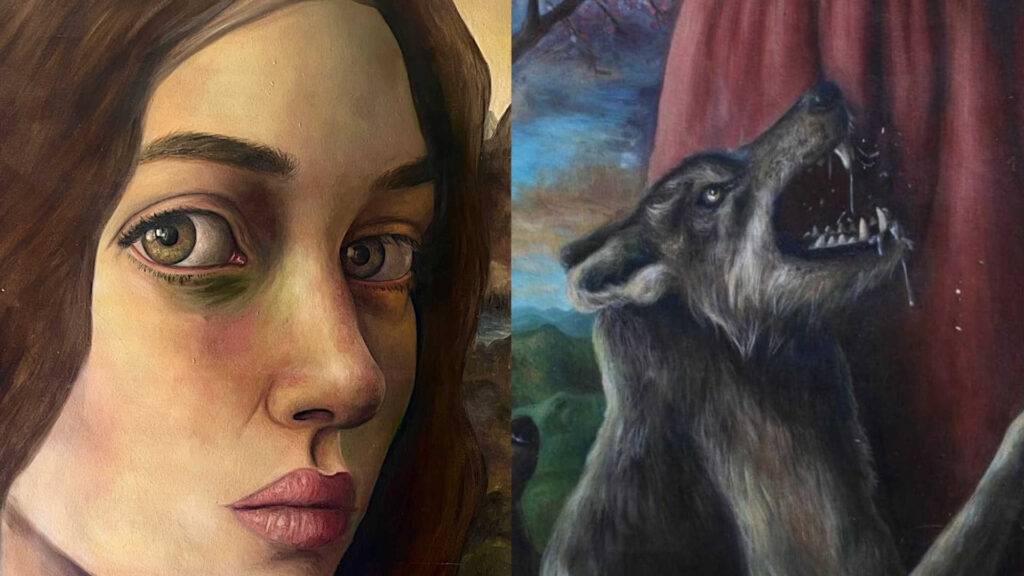
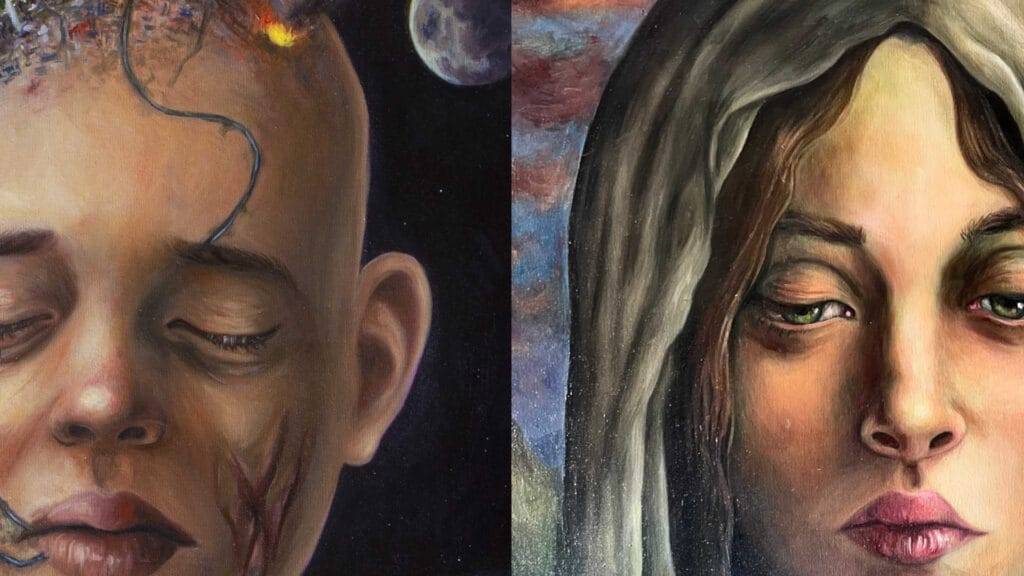
In contrast with the nihilistic and superficial secular Western vision of existence, Enrico Ibrahim Deiana seeks to communicate fragments of essentiality, crumbs of living sensations, visual representations of the relationship between Light and Darkness, a theme today largely ignored by Western society which, as mentioned, prefers to focus attention on materialistic needs, on benevolent-sounding discourses of actually violent politics more concerned with annihilating the past and the beauty of our peoples, rather than improving our conditions of life on the planet.

What is promoted from above are frivolous themes devoid of transcendence, the insignificant, the pathetic, degradation and hedonistic perversion; all is tied together by a common thread that seems to attempt to suppress every ideal of ancient beauty and immortal values, making us forget the beauty of the Absolute, the miracle of Existence, the poetry of Life, the achievement of great human goals and the Uniqueness of Creation, making us feel more like monkeys than men, from an evolutionary perspective.

The goal set by Enrico is the development of an art that goes beyond, that speaks to those who behold it, that awakens dormant ideals, that makes one reflect with unexpected themes, that in some way, indirectly, promotes the values of Abrahamic existential conceptions, which today would bring great benefit to Western culture, namely the contrast between Good and evil, between Truth and falsehood, concepts he allows to be glimpsed in the gaze of a character, in an expression, in an unusual depiction, in the pain of one who drifts away from Hope, concepts that can even be embraced by a secular and non-religious ideology.

According to Enrico, the artist is like a hermit on Earth, a pilgrim walking a path, a journey in search of Truth; a narrow and difficult road but one that offers great spiritual gifts to the artists, allowing them to find fragments of universal consciousness along the arduous journey, which become then crystallized in the form of art according to the limited human abilities; small gems that the artists find, preserve, and show to those they meets along his life.

Being an artist today, in a world so decadent, losing its sense of reason and accumulating madness and selfishness, is a way to remind the human species of what we truly are; we must never forget why we are on this Earth and how little time we truly have to grasp a higher existential purpose, becoming something greater.

Life is a spiritual journey, and the artists, through their works, must strive to remind it to those who are willing to listen.

error:
Scroll to Top
Privacy Overview

This website uses cookies so that we can provide you with the best user experience possible. Cookie information is stored in your browser and performs functions such as recognising you when you return to our website and helping our team to understand which sections of the website you find most interesting and useful.