
“The images used are for purely illustrative and decorative purposes. They are not intended to represent factual reality nor to offend the integrity of persons, places or events.”

Let’s imagine being a financial investor who, instead of dealing with traditional investment products in the world of finance, trades cultural products, betting on their rise in value.
Such an investor would notice that in recent years, modern culture tied to a certain extremist political ideology, the so-called “wokeism” (with no intention here of discriminating against any individual), a strange degeneration of Neo-Bolshevik ideology that heavily influences Western culture today; it has dominated the market and media landscape, consistently staying at the top compared to its competitors, despite strong dissent and a lack of public interest, completely ignoring consumer preferences.
Only public figures entirely dependent on the dominant system have taken it seriously, praising this comical ideology, as do cinematography, mass media and news services, attempting to promote it and push it toward mass acceptance. However, the result has been to be rejected and even ridiculed by the public itself.
If it’s not the public driving demand, but rather the push comes from above, requiring continuous funding and favorable propaganda to sustain it, we can conclude that this is not a genuine “trend” but a financial bubble.
When the bubble is no longer propped up by substantial sums, it always bursts, dragging down into the abyss anyone who supports it, unless they exit in time and pivot to the new trend.
Now, let’s imagine being an art collector who invested millions of dollars in modern and contemporary artworks, convinced that these pieces were a “safe haven currency” capable of retaining their commercial value indefinitely, if not even increasing it… What would happen if the narrative legitimizing modern art were somehow fractured and lost its effectiveness?
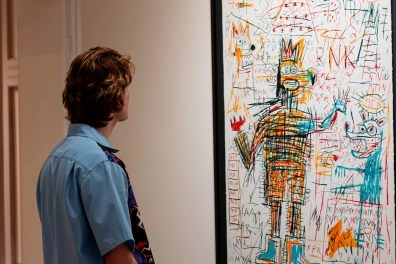
What would happen if splattered paint on canvas (let’s think about Jackson Pollock’s dripping, 1912-1956), invisible art (pioneered by Yves Klein, 1928-1962), or cans of so-called “Artist’s Shit” (by Piero Manzoni, 1933-1963) suddenly lost all their value… and museums, galleries and collectors were left with objects considered nothing more than junk or garbage?
What economic damage would such a situation bring to the investors, this likely “trend reversal” we’re discussing? Imagine how many art galleries would go bankrupt, how many private collections would become worthless scraps and how many art history books would become laughable, no longer making sense.
Before a financial bubble bursts and the value of its stocks plummets to rock bottom, a savvy and experienced trader would abandon the sinking ship, recouping their investments while market prices are still favorable and the strong signals of a downturn are evident.
What if we were about to directly experience a reversal of Western society’s values, a return to tradition that would stigmatize and ridicule everything considered valuable in modernity? What would happen if this artificial bubble, which the public has grown tired of, were to burst?
Indeed, we can observe in recent times clear signs of a trend reversal regarding the dominant political narrative. The “MODERNIST” element, the dominant Western narrative of the last century, has reached its peak… and we’re starting to notice a lack of momentum in the trend, which seems to persist only thanks to artificial injections of cash from the usual multinational corporations, giving it the appearance of still being on top; in reality, they are artificially keeping a corpse’s heart beating, attempting to revive it.
In recent years, political correctness, the modern culture of inclusivity and the celebration of weakness were never criticized by mainstream media; for years, self-proclaimed artificial minorities were heavily funded and constantly pushed into the spotlight, while true talents and geniuses, unfortunately not identifying as these new artificial minorities, were left to starve and ignored.
For years, we lived in a rosy soap bubble where everything pink, artificially rainbow-scented, and self-proclaimed as “different” was promoted, while everything traditional and rooted in cultural heritage was ridiculed and insulted; then, when the narrative bubble began to tilt, we all witnessed an incredible wave of conservatism that, step by step, began dismantling everything the rainbow left had built over recent decades, effectively ridiculing it and stripping it of political power.
The modern left’s trend, which we can historically trace in the art world to the official start of the DADA movement (though it appeared with different connotations, focused on anarchy and anti-academicism), now seems to be gasping for air before a potential collapse. When a trend reaches its historical peak and strange divergences emerge between attempts to promote it and failures in its implementation, we realize we’ve reached the point of a likely complete trend reversal, revealing that it was nothing more than an artificially inflated financial bubble.
This reversal, when it occurs, will affect every aspect of society, not just the arts, as Dadaism itself branched out into every cultural sphere of the West, influencing it with its relativist ideology.
Similarly, the restoration of values, unlike “degenerate modernism,” will naturally self-sustain like a healthy organism aiming for growth, not self-destruction, as the modern left does, ignoring what is good and promoting disaster.
Art in the last century appears dead, ridiculous, and if it weren’t useful today for social engineering, tax evasion, money laundering by large entities, or moving vast sums for illicit purposes like corruption or illegal trafficking, no one would have ever taken it seriously. Who, in good faith and without ulterior motives, would spend millions of dollars on splattered paint on canvas?
A shrewd businessman might buy it for far more pragmatic reasons, some of which we’ve outlined and if modern art were to collapse as a “tradeable asset,” it would be wise to abandon it as soon as possible.
“The end justifies the means” is their motto, so even buying worthless junk is acceptable as long as it holds virtual value.
Modernist culture has not brought real benefits to society; it has only slowed down the beauty the West was already developing; the technological and scientific progress of recent centuries is certainly not the result of weird violent blue-haired kids protesting in the streets, crying for abortion rights to extend to the ninth month of pregnancy.
Progress is the result of disciplined, motivated individuals rooted in tradition and millennia-old knowledge, striving to make their contribution.
Without massive financial injections, the Dadaist-inspired leftist culture would be labeled as delusional artistic creation and would collapse immediately, but since it was chosen as a Trojan Horse for purposes far different from those it proclaimed, it received enormous financial backing, giving it the appearance of success and legitimacy.
The time is ripe for its collapse and a new people is emerging, tired of harmful ideological pressure.
Investing in the art of restoration would enable the development of a new Academicism, a proliferation of classical arts and crafts; it would bring society to a new Renaissance, changing the entire course of human history and bringing immense benefits to the nations that embrace it.
Continuing to invest in those who are losing and degrading society will certainly not lead to long-term profits, because nobody would like to prosper in a civilization fallen into the abyss.
Restoring culture to a healthy path would lead to prosperity and widespread wealth; a sick art instead, as we can see from its fruits today, has led us to the degeneration and destruction of the social fabric, risking the extinction of several Western ethnicities due to a drastic decline in birth rates.
Today’s conservatism has proven itself highly culturally prepared, dismantling through debates and media ridicule, every focal point the left has relied on in recent years, though it is often a controlled opposition that avoids the core issues.
Academic art must follow the same path and dismantle the fairy tale of modern art (read the story here), which has been imposed on art history and made official by a political class that preferred to sell out its values for personal profit at the expense of public cultural health.
It is time for the art of restoration to develop, building a bridge between the 1800s and the new millennium, naturally recovering everything good that the avant-garde brought, because demonizing everything is never a solution; instead, we must observe with a neutral gaze and recognize the merits and flaws of any area. Any positive element will be assimilated, while the rotten parts will be discarded.
Over the last century, interesting artworks were indeed created, but only because they sought to reconcile tradition with contemporary dilemmas; those who instead dove into the extremization of artistic conceptualism, in the style of Marcel Duchamp’s (1887-1968) urinal rotated 90 degrees and proclaimed as new art, will be forgotten by history and buried in the graveyard of those who sold their moral values.
We must therefore value the useful discoveries of contemporary art; new materials, like silicone resins have been developed, enabling the creation of extremely realistic artworks.
Philosophically, the use of highly subjective and daring perspectives in painting has had its advantages, as has breaking certain rules of etiquette to create different works and less formal exhibitions that evoke the genuine artist’s studio, a place of inspiration, fostering a real connection between art and the public.
Genuineness is an important characteristic of contemporary art, which, when paired with Academicism, becomes a mix of sincerity and advanced technique; a bridge must be built with viewers, showing them the human side and the research and suffering behind every artwork’s creation. These are valid elements that must be absorbed into the new art to avoid becoming rigid and closed to innovation again. Such rigidity would lead to another fall, becoming the weak point of the Academic Institution, as happened at the end of the 1800s with the conflict between the Academy of Fine Arts of Paris and the Impressionists “Salon des Indépendants”. Standards must remain high, as must the messages conveyed, while staying open to creative experimentation that is qualitatively worthy of being presented to the public.
It requires open-mindedness, but a healthy openness aimed at building something better, an elasticity guided by reason, not to lower standards but to elevate them in a union of rationality and emotion.
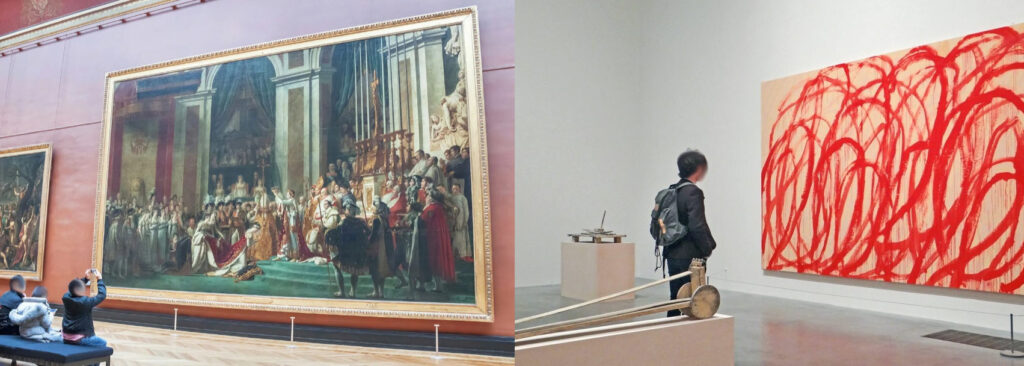
Investing in new art through donations/purchases
Purchasing Restoration artworks is an excellent way to accelerate the process of change, which will inevitably happen over time, as self-repair for beneficial purposes is what Nature and the Universe autonomously achieve in the process of self-preservation; investing in academic education with the opening of programs dedicated to the restoration of culture, promoting art with awareness-raising exhibitions and divulgative publications is the perfect counteroffensive to heal the world.
We want the academic school program to become mandatory in all art institutions, so that the paradigm can be re-established and intellectual quotients can rise again; art must earn the respect that the Sciences have and has to no longer be treated as the last wheel on the cart.
We want the art history of the last century to be revised and subjected to critical scrutiny, uninfluenced by monetary corruption.
Scan the QR code to donate:


For donations, contributions, collaborations, purchases, and events, use the form below.